Composite is a structural design patterns.
Via wikipedia:
The composite pattern describes that a group of objects is to be treated in the same way as a single instance of an object. The intent of a composite is to “compose” objects into tree structures to represent part-whole hierarchies. Implementing the composite pattern lets clients treat individual objects and compositions uniformly.
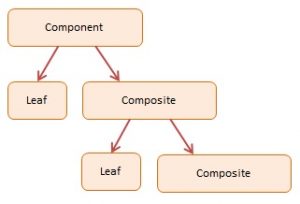
Component – An interface that defines the behavior for a particular object or group of objects
Leaf – Single object that has no descendants, implements the interface Component
Example
Let’s see how it works on a simple example of how to solve the equation ((((2+5)-1)*4)/3).
// Component - Common interface for nodes and leafs
public interface IOperation
{
    // Calculate the value of expresseion
    double Calculate();

    // display expression
    string Show();
}
//leaf
public class Number : IOperation
{
    public double a { get; set; }
    public Number(double _a)
    {
        a = _a;
    }
    public double Calculate()
    {
        return a;
    }

    public string Show()
    {
        return a.ToString();
    }
}
Now we implement classes(composite) that represent arithmetic operations like addition, multiplication, divide and subtraction.
//composite
public class Add : IOperation
{
    public IOperation b1 { get; set; }
    public IOperation b2 { get; set; }

    public Add(IOperation a1, IOperation a2)
    {
        b1 = a1;
        b2 = a2;
    }
    public double Calculate()
    {
        return b1.Calculate() + b2.Calculate();
    }

    public string Show()
    {
        return "(" + b1.Show() + "+" + b2.Show() + ")";
    }
}
And the same will be in other classes with arithmetic operations only difference is a method of Calculate and Show
Divide:
public double Calculate()
{
    return b1.Calculate() / b2.Calculate();
}

public string Show()
{
    return "(" + b1.Show() + "/" + b2.Show() + ")";
}
Multiplication:
public double Calculate()
{
    return b1.Calculate() * b2.Calculate();
}

public string Show()
{
    return "(" + b1.Show() + "*" + b2.Show() + ")";
}
Subtraction:
public double Calculate()
{
    return b1.Calculate() - b2.Calculate();
}

public string Show()
{
    return "(" + b1.Show() + "-" + b2.Show() + ")";
}
Now let’s apply our pattern for the calculation of expression ((((2 + 5) -1) * 4) / 3)
static void Main(string[] args)
{
    // build the following expression ((((2+5)-1)*4)/3)
    Number a = new Number(2);
    Number b = new Number(5);
    Add addition = new Add(a, b);

    Number c = new Number(1);
    Sub subtraction = new Sub(addition, c);

    Number d = new Number(4);
    Multi multiplication = new Multi(subtraction, d);

    Number e = new Number(3);
    Div divide = new Div(multiplication, e);

    Console.WriteLine("Result of: {0} is: {1}", divide.Show(), divide.Calculate());
    Console.WriteLine("Result of: {0} is: {1}", multiplication.Show(), multiplication.Calculate());

    Console.ReadKey();
}
As u see in this approach we combine multiple objects into a single object and we perform methods on it. We can also refer to any of these objects.

Summary
Link to the project : here




What mistake? 😉
Corrected. Thank You 😉